Oct 4 2019 - Oct 4 2019
The Durrës Amphitheatre
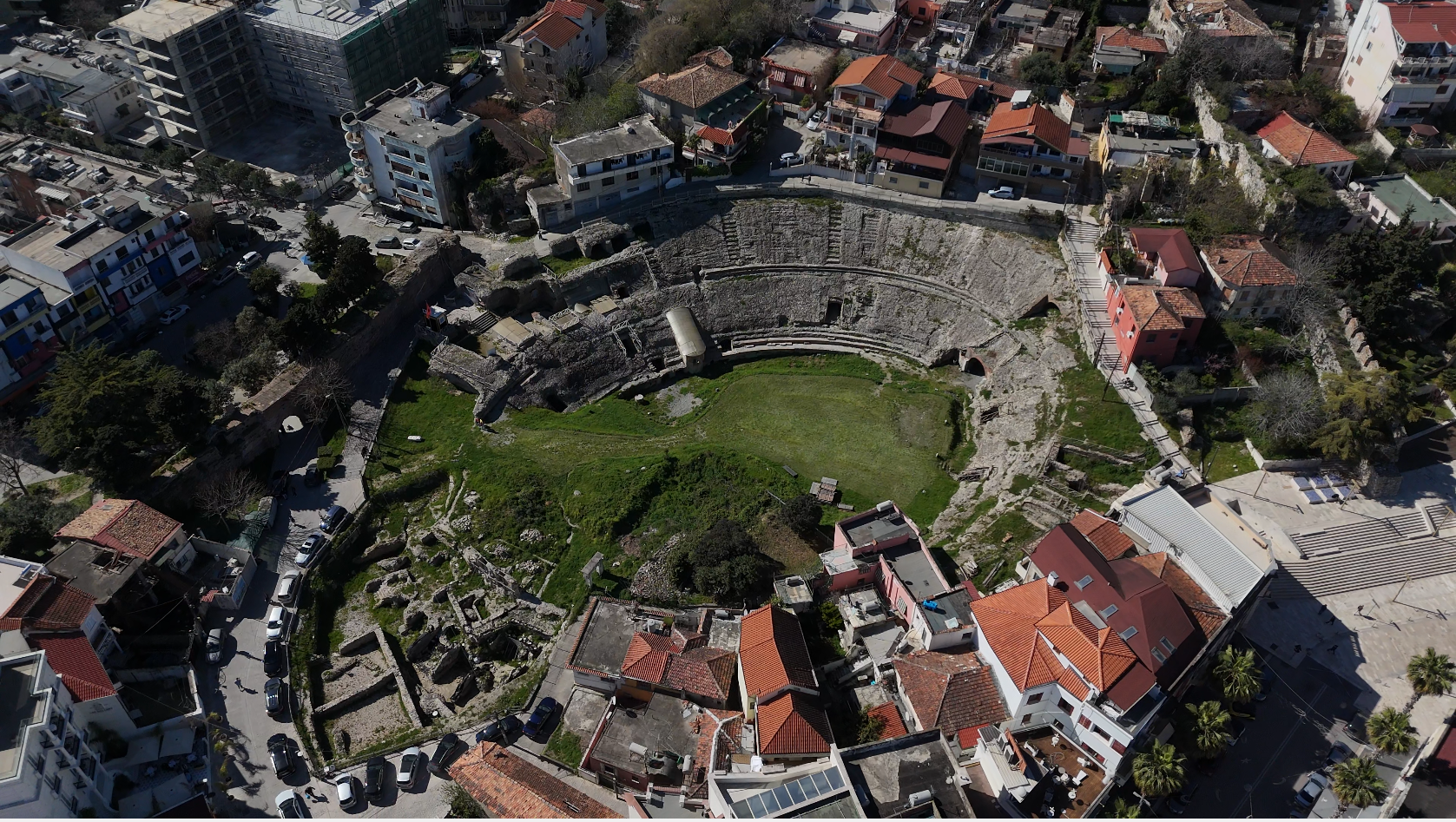
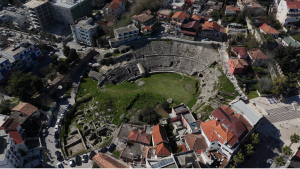
The Amphitheater in Durrës was built by the Romans more than 2,000 years ago — one of over 200 amphitheaters constructed throughout their vast empire. When famed historian Marin Barleti (Mah-reen Bahr-leh-tee) saw it in the fifteenth century, he declared:
“In Durrës… an arena or an amphitheater has been built with admirable skill and mastery.”
Even though by this time, the 2nd-century colossus of Roman architecture had suffered significant damage, the monument retains its glory to this day, as it resides in the city’s contemporary landscape.
The amphitheater lay hidden for centuries until 1966, when local archaeologist Vangjel Toçi (Vahn-gel Toh-chee) happened upon a fig tree that had fallen a few meters below ground level near the base of the Durrës Castle. Upon further excavation, he discovered the ancient amphitheater buried beneath. The Roman-style, fully enclosed elliptical amphitheater is a descendant of ancient Greece’s two-sided stadiums and semicircular theatres. The Romans added new features like protective walls between spectators and the arena, tiered seating, elaborate details, and grand entrances.
The underground waiting rooms below the arena would house the people, props, and animals that participated in the spectacles. Located in the western part of the ancient city, a few steps from the Adriatic coast, the remarkable structure was built at the height of Roman architecture. It is often hailed as “one of Trajan’s marvels” — referring to one of the Five Good Emperors who ruled the Roman Empire from 98 to 117 A.D. However, some historians point to its construction occurring during the reign of Trajan’s successor, Hadrian, who was responsible for other notable structures like the aqueduct and Roman baths.
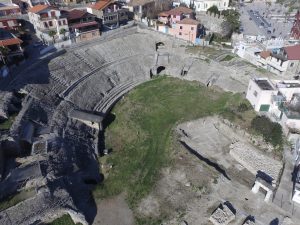
The surrounding fortification walls were erected much later, in the 6th century A.D., during the reign of the Durrës-born Roman emperor Anastasius I Dicorus (491–518 A.D.). Only one half of the oval-shaped monument has been excavated and is currently visible. Constructed by local masters, the amphitheater was built using opus incertum, a Roman construction technique that alternates rows of brick with a mix of stones and mortar, designed to withstand earthquakes — a common occurrence in Durrës. The entertaining and often brutal gladiator spectacles constituted a point of climax for the Durrës Amphitheater, which could accommodate 15,000 to 20,000 spectators in its tiered staircases.
The underground tunnels, known as vomitoria, functioned as paths to the arena for gladiators, beasts, marshals, and other participants. The end of all spectacles occurred around the 4th century A.D., under Emperor Honorius (393–423 A.D.), whose rule coincided with the beginnings of the fall of the Roman Empire. In the late 3rd and 4th centuries A.D., the Roman Empire’s economic decline led to a lack of funding and attention for gladiatorial battles. The Christian Church rose to power and eventually banned these activities due to their perceived immorality.
In the 3rd century, wild beast fights, gymnastics, and theatrical acts were popular in the amphitheater. In the 5th century A.D., Emperor Anastasius I Dicorus restored the amphitheater — among other initiatives — to protect it from the church’s potential appropriation or destruction in his birth city of Dyrrhachium (Deer-ah-kee-uhm). Signaling a time of penance for the unrestrained amusement of earlier centuries, the ancient arena and vomitoria of the gladiators were turned into a cemetery, and at least three small chapels were built in the galleries. In the late 8th and early 9th centuries A.D., a larger chapel was built in one of the galleries for the religious rituals of the Christian community.
The Main Chapel contains several beautiful mosaics and frescoes. Somewhat poorly preserved, the frescoes depict the Pantocrator (pan-tok-ruh-tur) as theophany on the ceiling — a popular design in the 9th century A.D. The frescoes were later replaced by mosaic panels depicting St. Stephen, the Durrës martyr, as well as St. Mary, St. Eirene, St. Sophia, and St. Gabriel. The best-preserved mosaics, on the south wall, depict St. Stephen wearing a white tunic with red clavi, and the Virgin Mary flanked by angels and two figures — most likely short-lived donors, Emperor Alexander and his wife — with the prayer “Lord, safeguard your servant Alexander” written above the angel’s head.
By the turn of the century, the amphitheater’s previous splendor had all but vanished. The 1273 earthquake contributed to further deterioration. In the 15th century, there were traces of domestic activity in the already demolished gallery. By this time, little of the formerly grandiose monument was visible and the area was covered with residences. Yet, this was also the moment that Marin Barleti recorded his impressions of the monument.